Everyone who brews coffee at home runs into this at some point: same coffee, same scale, same water, and the cup is wonderful one day and flat the next. Most of the time the culprit is the grind. In this post we want to explain what grind size does, how to think about it and where to start for each method. It is a long read, but you will come out with one simple rule you can use.
What grind size actually does
When you grind coffee you decide how much surface area the water will touch. A fine grind means a lot of surface: water pulls compounds out of the coffee fast. A coarse grind means less surface: in the same time, less dissolves. The total of what dissolves is what we call extraction.
Low extraction (coarse grind or short contact) gives a cup that is sour, thin, salty and short. High extraction (fine grind or long contact) gives a cup that is bitter, dry, astringent and lingers in the throat. Somewhere in between the coffee is sweet, balanced and finishes long. That is the place we are looking for.
Sour or bitter
The only real way to dial in a grind is to taste. But telling sour from bitter is harder than it sounds. A simple test: let the cup cool a little and pay attention to what stays in your mouth after you swallow. A sharpness on the sides of the tongue that makes you salivate is sourness; grind finer. A dryness and puckering at the back of the tongue and in the throat is over-extraction; grind coarser. Change one step at a time and write it down.
Starting points by method
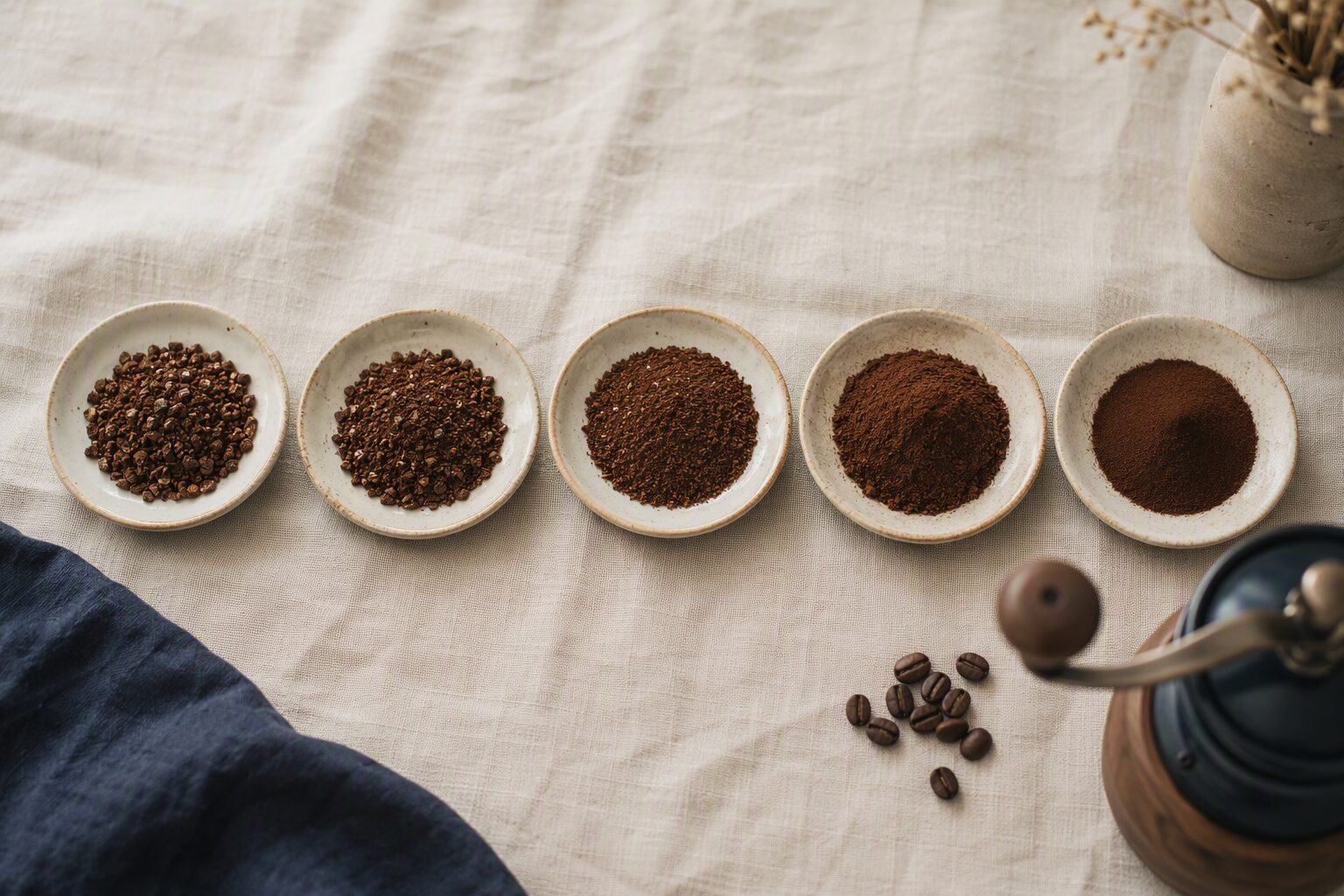
The descriptions below refer to texture you can see and feel, not to a number on your grinder. Every grinder has its own scale; texture is the shared language.
- Espresso — fine, between flour and caster sugar. Clumps when pressed between the fingers.
- AeroPress — medium-fine, fine sea salt. A quick method, so it tolerates a slightly finer grind.
- V60 — medium-fine, sea salt. If the draw down runs well past 3 minutes, go coarser.
- Drip machine — medium, sand. Works well at the 1:15 ratio printed on the box.
- Chemex — medium-coarse, coarse sea salt. The thick paper filter does not forgive a fine grind.
- French press — coarse, breadcrumbs. Coarse grinding reduces sediment and balances the 4-minute steep.
Why the grinder matters so much
Consistency matters as much as size. Blade grinders smash coffee rather than cutting it, so the same batch contains dust and large chunks together. The dust over-extracts, the chunks under-extract, and you taste both in the cup: bitter and sour at the same time. That is why our first equipment recommendation is always a good hand grinder, not an expensive kettle or scale.
Keep your grinder clean. Old coffee oils build up between the burrs and carry into every new coffee. Emptying and brushing it out once a month is enough.
Does grinding fresh really matter
Yes, and sooner than you might think. Coffee starts losing aromatics within minutes of grinding; after a day the difference is clear, and after a week most of the character is gone. Our box says "use within 2 weeks of grinding"; that is the upper limit for ground coffee. If you do not have a grinder you can order from us pre-ground, but buy a small bag and finish it quickly.
The simple rule
When you open a new coffee, keep your recipe (ratio, water temperature, time) fixed and adjust only the grind. If it is sour, go finer; if it is bitter, go coarser. When you find the spot you like, write it down. The next lot of the same coffee may be a little different, but now you know where to start.
Our brew guides have a starting recipe for every method. Write to us if you get stuck; talking through why a cup tastes the way it does is our favourite kind of work.